Kelli Marshall
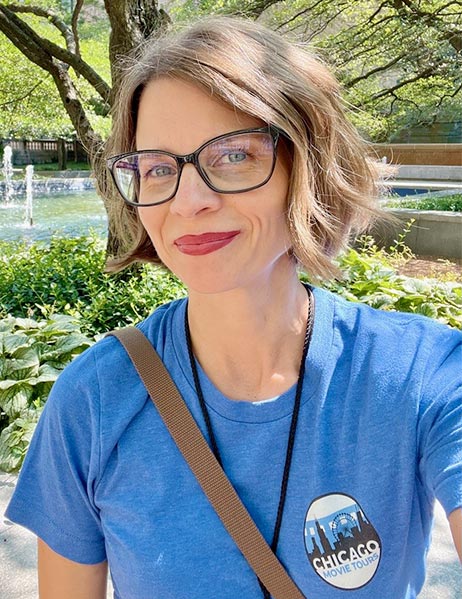
Kelli Marshall is a tour guide, educator, and public speaker who brings film history to life for audiences of all backgrounds. As the founder of Chicago Movie Tours, she helps visitors and locals discover Chicago through its rich cinematic history. Before launching her business, Kelli spent over a decade as a professor of film and media studies. Now, she brings her expertise and passion for teaching beyond the traditional classroom and into real-world and virtual experiences. Kelli holds a Ph.D. in Humanities, an M.A. in English, and a B.A. in English, with minors in history and French.
INCLUDE
A Brief History Of Hollywood Film
Explore the evolution of Hollywood cinema in this hour-long lecture, tracing the industry from its humble beginnings to the 1980s. Specifically, you’ll learn about three eras of Hollywood’s history: (1) early cinema and the coming of sound, (2) classical Hollywood and the studio system, and (3) The New Hollywood. Can we do it all within 60 minutes!? Yes!
Festivus 101: A Celebration For The Rest Of Us
Venture into the world of Festivus, the quirky holiday created by the brilliant minds behind the TV series Seinfeld. Celebrated annually on December 23rd, Festivus is the ultimate celebration “for the rest of us.” This unique holiday emerged as a humorous antidote to the commercialism and traditions of Christmas, and its symbol is a simple, yet symbolic, silver pole devoid of any decorations. In this hour-long lecture, you’ll explore the history of Festivus and discover how this unconventional (and arguably, Jewish-based) holiday was born.
Film Noir: Hollywood’s Darkest Timeline
Uncover the gritty plots, seedy characters, and dangerous cities that make up American film noir. Featuring major studio releases like The Maltese Falcon and Double Indemnity as well as B-movie fare like Detour, this 60-minute lecture gives participants a solid overview of film noir: its French origins, cultural influences, genre problems, character types, and aesthetics.
Mardi Gras And Movies In The Midwest
Explore the history of Mardi Gras and a few of its 200+ onscreen depictions! In this hour-long lecture, you will enjoy a short history of Mardi Gras, including the meaning behind its name and regional and global traditions. You will also consider movies that depict the famous New Orleans-based celebration, and learn why this annual raucous event has translated well to the silver screen since 1898. Finally, you will compare pączki, a Fat Tuesday pastry common in the Midwest, to New Orleans-style king cake, a ring of twisted dough stuffed with a sweet filling and a plastic baby doll. Laissez les bon temps rouler!
Behind The Scenes: National Lampoon’s Christmas Vacation
National Lampoon’s Christmas Vacation (1989) follows the Griswold family as they attempt to create the perfect traditional Christmas celebration. However, as is usually the case with this fictional family, everything that can go wrong does. Amidst the onscreen chaos, have you ever wondered what happened off-camera during the making of this iconic holiday film? Do you know where the movie was shot? Have you noticed the film’s ties to Lethal Weapon, Betty Boop, and It’s a Wonderful Life? This hour-long lecture will answer these questions (and more!) as we go behind the scenes of Christmas Vacation and dive headfirst into the world of the Griswolds.
Inside Gene Kelly’s House
Celebrate one of classic Hollywood’s greatest song-and-dance men with a tour to his Beverly Hills home(s). In the process, you’ll discover the star’s Pittsburgh and Chicago connections, see rare excerpts from vintage movie fan magazines, and learn how the activities taking place inside Gene Kelly’s house helped reshape MGM movie musicals of the 1940s and 1950s. This lecture runs about 60 minutes.
Chicago Murals And Movie Stars
With the help of HD video, this 60-minute lecture takes guests to massive murals in Chicago. The first mural is devoted to Dolly Parton: singer, songwriter, actress, LGBTQ+ icon, and philanthropist. The second mural celebrates Robin Williams, born in Chicago in 1951. The third mural depicts film producer Quincy Jones, who survived a “rough and scary” Chicago childhood. NOTE: Due to the violent nature of Jones’ backstory, this segment of the lecture may not be appropriate for children.
The Marx Brothers And Bob Newhart: Comedy In Chicago
Chicago has produced many comedy legends, and this hour-long lecture considers two of them: the Marx Brothers (collectively) and Bob Newhart. We’ll start with a leisurely walk to the Marx Brothers’ Chicago home, which you’ll experience via HD video. There, you will learn about a subgenre of film called anarchic comedy. You’ll also take a ride down Route 66 and see where the Marx family once owned a chicken farm. (Yes, a chicken farm!) Then, we’ll shift comedic gears to Bob Newhart. Newhart was born in Chicago, and his sitcom The Bob Newhart Show (1972-78) was set there as well. In this section, you’ll visit 3 locations (again, via HD video) near and dear to the comedian and actor, all while learning about his significance to American comedy history.
The Wizard Of Oz And Chicago
Although set in Kansas and filmed in Hollywood, The Wizard of Oz (1939) has many Chicago (and Illinois) connections. This 60-minute lecture introduces you to several of them. First, you will stroll (via HD video) through a Chicago park that pays tribute to the Tin Man, Scarecrow, Cowardly Lion, Dorothy, and Toto. Then, you will follow Chicago’s yellow brick road to the spot where L. Frank Baum wrote his children’s book The Wonderful Wizard of Oz. There, you’ll also hear about the World’s Fair that inspired the author. Finally, we’ll meander briefly through Evergreen Memorial Cemetery in Bloomington, IL, for more Oz stories.
Behind The Scenes: National Lampoon’s Christmas Vacation
Set in the Chicago suburbs, National Lampoon’s Christmas Vacation (1989) follows the Griswold family as they attempt to create the perfect traditional Christmas celebration. However, as is usually the case with this fictional family, chaos ensues. Yes, everything that can go wrong does.
• Have you ever wondered what happened off-camera during the making of this iconic holiday film?
• Do you know where the movie was shot?
• Have you noticed the film’s ties to Lethal Weapon, Betty Boop, and It’s a Wonderful Life?
In this holiday lecture, go behind the scenes of Christmas Vacation and dive into the world of the Griswold family. You’ll challenge your knowledge of the movie and discover fun facts that will make you appreciate the film even more. You’ll also hear about Chicago’s (minor) role in creating the perfect backdrop for the Griswold’s holiday misadventures.
Beyond The Blues Brothers
Celebrate the 1980 movie The Blues Brothers as you explore its backstories, mix of Hollywood genres, and impact on Chicago-based filmmaking.
This hour-long interactive lecture considers:
• Backstories of the 1980 movie and the Blues Brothers’ act, made famous on SNL.
• Conventional Hollywood genres and 10 ways The Blues Brothers film, for better or worse, insists on mixing them.
• The movie’s impact on Chicago-based filmmaking, with a special nod to Jane Byrne, who served as Chicago’s mayor during the film’s production.
Chicago, Christmas Movies, And Class
National Lampoon’s Christmas Vacation (1989), Home Alone (1990), and While You Were Sleeping (1995) sit amongst the most beloved American Christmas movies.
Set in Chicago at Christmastime, these three mainstream Hollywood comedies have entertained audiences for decades. But have you ever thought about why? Which characters make you laugh or cry? And what does their social class—lower, middle, or upper—have to do with your reaction?
Let’s find out in this hour-long lecture on class stereotypes in Chicago-based Christmas movies!
From Ferris To The Frontlines: Chicago’s Art Institute And Grant Park In The Movies
The Art Institute of Chicago and Grant Park are not just beloved city landmarks—they’ve also played unforgettable roles on the big screen. In this hour-long lecture, explore how both of these public spaces have been represented in film, sometimes as places of whimsy, sometimes as sites of unrest. Specifically, you will:
• Stroll (virtually) along Michigan Avenue to visit the Art Institute of Chicago and its famous lions
• Explore how one of John Hughes’ beloved ‘80s teen comedies transformed a museum visit into a cinematic moment
• Step into Grant Park, a sprawling downtown green space rich in political and pop culture significance
• Learn how a recent historical drama restaged one of Chicago’s most turbulent protests
• View original HD footage you won’t find anywhere else—captured and curated just for this talk
See familiar city landmarks in a new light—through the lens of film—as we engage in conversation about place and media.
Planes, Trains And Automobiles, And The Trappings Of Home
Planes, Trains and Automobiles (1987) is frequently considered John Hughes’ best work. Its Rotten Tomatoes score is 92%. It ranks either #1 or #2 on lists from Variety, Screen Rant, and Movie Maker. Dan Ackroyd even likens the movie to Arthur Miller’s great American play, Death of a Salesman, calling John Candy’s shower curtain ring salesman “the Willy Loman of his age.”
Why has Planes, Trains and Automobiles earned this elevated status in John Hughes’ body of work? It’s just a comedy with a simple premise, silly slapstick, and caricatures as leads, right?
Yes, the movie is all of that. But it is also perhaps Hughes’ most mature screenplay.
In this lecture featuring HD video footage, you’ll visit the suburban Chicago house where Planes, Trains and Automobiles ends. You’ll hear plenty of behind-the-scenes stories. And you’ll discover how the movie intertwines humor with the complex notion that “home” is both a comfort and a constraint.
The Breakfast Club And Chicago
This hour-long lecture on the 1985 movie The Breakfast Club unfolds in two parts: First, we’ll walk virtually around the former suburban Chicago high school where The Breakfast Club filmed. While we cannot go inside with a video camera (we have pics though!), we can explore the building’s exterior and learn how it reflects a group of teenagers who feel imprisoned by their high school culture, peers, and parents. Second, we’ll examine Simple Minds’ song “Don’t You (Forget about Me),” featured memorably in The Breakfast Club. In the process, you will hear behind-the-scenes stories from John Hughes’ teen film, learn about the music’s connections to MTV, and understand how the iconic song still functions as a metaphor for victory. In short, through location and music, we will discover how this Chicago-based movie defines a generation of moviegoers.
Gender in Focus: How Hollywood Portrays Women and Men Onscreen
Course (or Series)
In this two-part course, explore 8 ways Hollywood often represents gender onscreen. You’ll learn about common gender stereotypes and body representation, both of which reveal (often troubling) cultural insights. Each 60-minute lecture can also stand alone and be booked separately.
Gender In Focus: Week 1
How Hollywood Portrays Women. Encounter four ways Hollywood has traditionally represented women onscreen. Among the categories you’ll consider: mothers, damsels, femme fatales, and domestic or romantic agents. You’ll also get a primer on how movies have chosen to represent women’s bodies over the years, particularly when few clothes are involved.
Gender In Focus: Week 2
How Hollywood Portrays Men. Encounter four ways Hollywood has traditionally represented men onscreen. Among the categories you’ll consider: macho men, comedy nerds, wounded warriors, and beasts. You’ll also learn why nude (or mostly nude) onscreen men often receive harsh punishment in the movie’s narrative.
Reel Talk: How to Think Critically About Movies
Course (or Series)
Master the art of watching movies in this four-part course. Over four hour-long lectures, explore the essentials of film art. Each session builds on the last: you’ll start with the basics and progress to more advanced concepts, ensuring a smooth journey into the world of film analysis. Taught by a Ph.D. with over a decade of teaching experience, this course is both fun and accessible. For an added bonus, book the optional lecture, A Brief History of Hollywood Film, to round out your experience!
Reel Talk: Week 1
Mise-en-Scene: How Are Movie Worlds Created? To tell you a story, a movie relies on settings, props, actors, blocking, costumes, makeup, and lighting—all of which exist independently of cinematography, editing, and sound design. If you’ve ever wanted to learn how these items, collectively called mise-en-scene (pronounced meez-on-sen), contribute to a film’s world and your perception of characters or particular moods, then join us! This hour-long lecture will also briefly trace mise-en-scene in film from 1900 to the present.
Reel Talk: Week 2
Cinematography: How Do Movies Guide Your Eyes? When you watch a movie, the images before you may seem like objective views of the world. But they are not. In fact, those images are purposefully constructed and then put onscreen—to guide your eyes where the director wants them to go. Sneaky, right? This hour-long lecture introduces you to the basics of cinematography, including speed of motion, perspective relationships, focal length, depth of field, and framing. Once you recognize how cinematography works, you can experience and understand movies on a new level.
Reel Talk: Week 3
Editing: How Do Movies Link All Those Images? If you hold up a piece of film stock, you’ll notice a series of images, one slightly different from the next. So how do those hundreds or thousands of separate images that comprise a movie ultimately make sense and then, hopefully, affect us emotionally as we watch? Learn the answer in this hour-long lecture on editing, where you’ll be introduced to the basics of editing, including the shot, shot transitions, types of relationships between shots, and two common editing styles.
Reel Talk: Week 4
Why Is Movie Sound So Powerful? A dinosaur’s roar, a dancer’s tap shoes, a lightsaber’s hum: each of these sounds conveys meaning in relationship to its accompanying image—respectively, terror, talent, and anticipation. If you’re interested in learning how such sounds are made, “sweetened,” and then rendered onscreen, then join us for this hour-long discussion on the relationship between sound and image. You’ll also explore several sound techniques; three types of sound (voice, music, sound effects); and the power of sound in cinema.
Reel Talk: (Optional) Week 5
A Brief History of Hollywood Film. Explore the evolution of Hollywood cinema in this hour-long lecture, tracing the industry’s journey from its humble beginnings to the 1980s. Specifically, you’ll dive into three eras of Hollywood’s history: (1) early cinema and the coming of sound, (2) classical Hollywood and the studio system, and (3) The New Hollywood.